Waste Water treatment

We will soon be launching our new range of waste water and effluent treatment products. Please come back and visit this section soon. Alternatively register for the Puresep Newsletter and be amongst the first to learn of our new product and service offerings

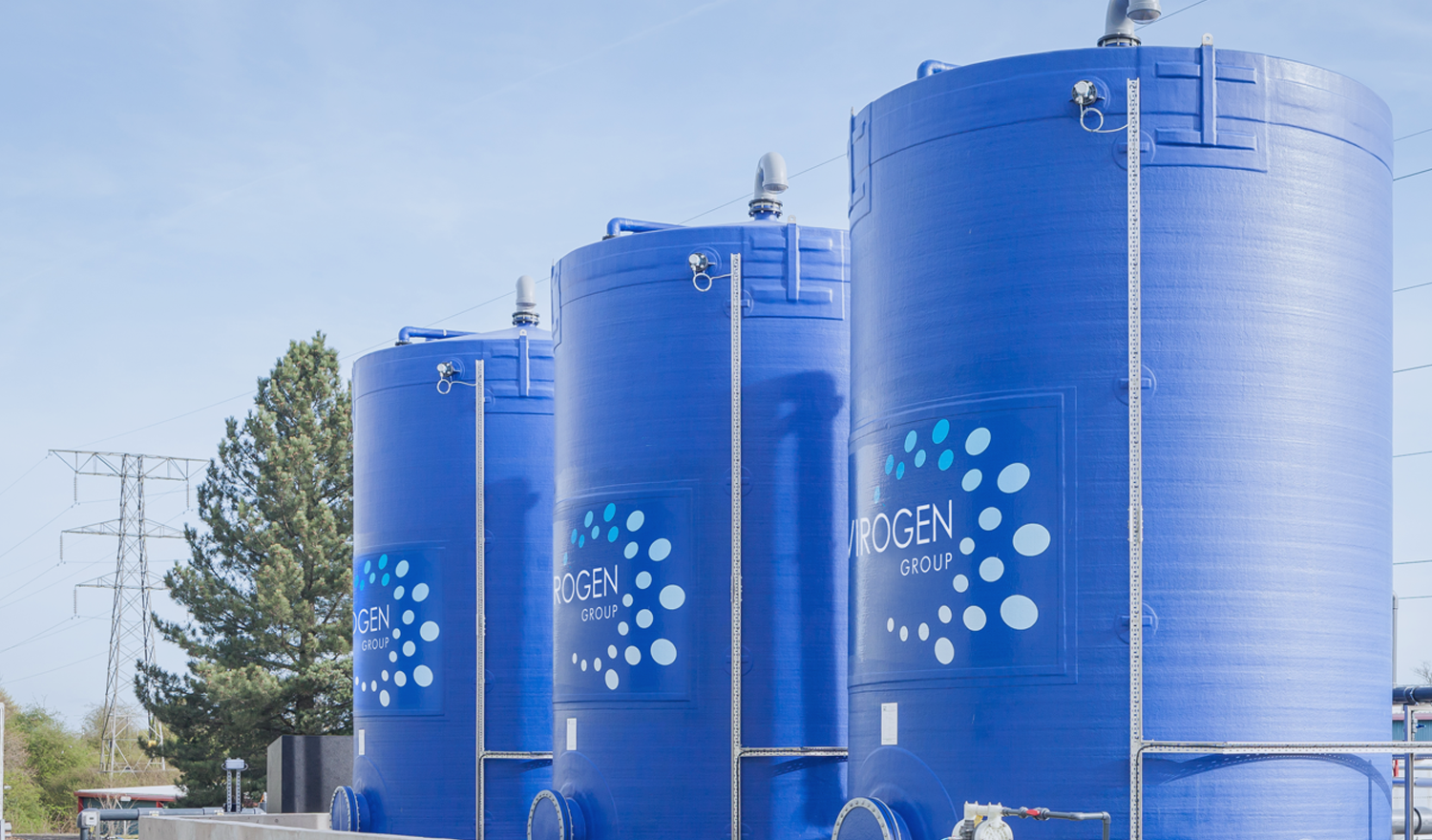
PureChlor Chlorine Dioxide

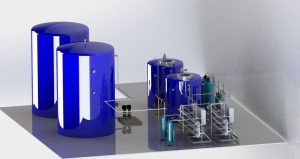
PureChlor chlorine dioxide is where chlorine dioxide is produced through the tightly controlled mixing of Puregen base reagents. Chlorine dioxide is a powerful disinfectant making it an effective and fast acting killer, by breaking down cell walls and attacking bio film leaving no resistant strains. It is well suited to a range of water treatment applications at low concentration, including CIP, feed water, product water and water re-use.  The PureChlor systems are PLC Controlled with full safety features and multiple point of use.
Benefits include:

  • Fast acting killer unaffected by the pH range it operates in
  • Hugely efficient low chemical usage ensuring a safer environment for everyone
  • Zero harmful chlorinated by-products
  • Easy future expansion
  • Single reagent storage area

PureChlor Chlorine Dioxide presentation

PureSec Electrochlorination

PureSec Electrochlorination systems generate onsite chlorine solution. Brine is converted to produce 1% chlorine solution by electrolysis; salt and power are the raw materials for the process. The solution is safe to store and stable for long periods with no loss of activity.  Multiple points of use can be applied from a common storage tank, with dosing control feedback via specific ion residual sensors.
Over recent years the PureSec electrochlorination system has gained favour, due to the elimination of transportation, handling and storage of chlorine gas or other disinfection chemicals. This results in a safe, reliable and economic method of disinfection.  The full range of PureSec systems are PLC controlled and have the flexibility to be configured to site specific process control requirements.  It is well suited to the treatment of product water, drinking water, cooling water, as well as other industrial applications.

Ultraviolet Irradiation

UltraViolet Irradiation (UV) is primarily employed as a disinfection process that inactivates waterborne pathogens without using chemicals, where UV light changes the DNA and protein structure of viruses and bacteria and stops them from reproducing.
Advantages of UV disinfection include:

  • Effective for all types of microorganisms
  • Low capital, operating and maintenance costs
  • Compact and easy to install
  • Efficacy is independent of pH
  • No impact to the aesthetic water quality
  • Safe and environmentally-friendly

Case Study:

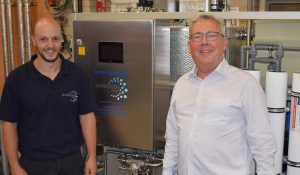
A Puresep Water UV system was recently installed at a soft drinks production factory, as a final sterilisation process. Upstream of the UV, town’s water is treated with a chlorine sterilant, to a prescribed residual with contact time.  To prevent water or final product tainting, a PureFlow Carbon adsorption process removes free residual chlorine.  Post UV, final filters offer cryptosporidium protection before supply to product make up.  A PureFlow Reverse Osmosis system treats the product make up water, to supply low mineral content water for isotonic beverage production, with a point of use UV steriliser on the treated water storage tank outlet.
For further details please download the following case study:

Ultra-Violet Irradiation Case Study

ION Exchange

Hardness forming salts such as calcium and magnesium and the sulphites, chlorides and nitrates (permanent hardness) of calcium and magnesium are the most troublesome constituents of natural water due to their tendency to form scale. These hardness salts can be removed by passing the water through an ion-exchange resin that removes the calcium and magnesium and exchanges them for sodium salts which are non scale forming. Scale build up be particularly hazardous and the build up of scale in cooling water and hot and cold water systems can harbour Legionella bacteria.

Puresep’s Ion Exchange systems provide treatment solutions for a wide range of specialist water treatment and product purification applications. Each application utilises a specific grade of ion exchange or absorption resin with a regeneration program to ensure repeatable batch treatment and product quality.

Puresep can supply a full range of ion exchange plant and equipment. We can also repair and maintain this equipment, supply replacement resin and resin cleaning chemicals as appropriate.

Softener

Puresep supplies an extensive and comprehensive range of Water Softening Plant.

Puresep Water Softeners uses the “ion exchange” method to reduce the amount of scale forming salts such as calcium and magnesium from a feed water source to prevent downstream scaling and accelerated corrosion of process lines of equipment. Scale forming salts commonly known as hard ions, are sparingly soluble and have a tendency to precipitate on to contact surfaces in the form of carbonates, sulphates and hydroxides.

A standard water softener works by allowing hard water to filter downwards through a bed of ion exchange resin. The ion exchange resin attracts the calcium and magnesium ions (hardness) and replaces them with sodium ions which are less problematic for water systems and will not cause scale build-up. Once the ion exchange resins are saturated with hardness, the regeneration sequence on the water softener begins.

The regeneration sequence starts with the backwash cycle which reverses the flow of the water to pass upwards through the ion exchange resin bed. This frees the beads of the ion exchange resin. Ion exchange resins are then saturated with a brine solution which releases the calcium and magnesium ions and replaces them with sodium ions. Both the calcium and magnesium ions flow along with the water and excess brine solution to drain. Using a down flow flush removes excess brine left on the ion exchange resin beds. The softener is then back into service mode.

The size of water softener required varies according to the flow-rate and the hardness of the water. Our team of expert engineers can provide assistance with this.

Demineralisation

Puresep supplies an extensive and comprehensive range of Demineralisation Plant for pure water and ultra-pure water. The high-purity water from a demineralised plant is typically used for high pressure boiler feed and any process where high-purity water is a requirement.

A Demineralisation Plant consists of two pressure vessels containing cation and anion exchange resins. Various types of ion exchange resins can be used for both the cation and the anion process, depending on the type of impurities in the water and what the final water is used for.

Typically, the cation resin operates in the hydrogen cycle. The cations in the water (i.e. calcium, magnesium and sodium) pass through the cation exchange resin where they are chemically exchanged for hydrogen ions.

The water then passes through the anion exchange resin where the anions (i.e. chloride, sulphate, nitrate and bicarbonate) are chemically exchanged for hydroxide ions.

The final water from this process consists essentially of hydrogen ions and hydroxide ions, which is the chemical composition of pure water.

Having installed demin plants at a number of key sites across the UK, the Puresep team of engineers are experts in ion-exchange water treatment plant.

Dealkalisation

Dealkalisation is used to remove hard ions associated with alkalinity, from a feed water source. Dealkalisation systems are often used as a pre treatment to softeners when a water source contains high level of alkalinity, and is associated with high levels of carbon dioxide in the stream. The two stage dealkalisation process includes base exchange followed by carbon dioxide gas stripping.

The Puresep standard range of Base Exchange Dealkalisation Plant effectively reduces the alkalinity and hardness salts from the water giving a water of the following composition:

  • Bicarbonate alkalinity - less than 5% average of the input alkalinity
  • Total dissolved solids reduction - approximately equal to the temporary hardness
  • Total hardness - less than 4 ppm

Combining the dealkalisation range with the softening plant range gives fully dealkalised and softened water.

Deaeration

Oxygen and carbon dioxide in water can have a debilitating affect.

Dissolved oxygen content in the feed water is a large factor in determining the amount of corrosion that will take place in piping, boiler and condensate handling equipment.

Beverages are sensitive to dissolved oxygen. Taste and colour can be substantially changed. Additionally, dissolved oxygen adversely affects filler performance.

Puresep’s Dearation units have been specially developed to meet the requirements of various industries in removing oxygen and carbon dioxide from water.

Chemicals and chemical management

Puresep delivers bespoke chemical treatments that prevent corrosion, fouling, scaling and stress cracking as well as assisting in water treatment and improvement of product quality. We manage your chemicals from start to finish: prescribing, formulating, delivering, storing, handling, dispensing and monitoring.

Our people will apply the right chemical solutions to help you deliver the maximum reliability and performance.

When it comes to your chemical requirements, we can manage the whole process, from recommending what you need, through to supplying them onto site and dosing into the required production process. We can also store chemicals at our two warehouse facilities.

Pureflow CrossFlow Filtration

The PureFlow Cross-flow membrane technology is quickly gaining global acceptance as an important manufacturing step in many process lines in industries worldwide. The ability to produce very specific separations at low or ambient temperatures with no phase change can, in many applications, make membrane filtration a more cost-effective solution than more conventional methods.

Cross-flow membrane filtration is a physical separation process. A feed stream passes across the membrane and is separated into two individual streams: the retentate and the permeate. The membrane is a semi permeable barrier, allowing some components from the feed stream to pass (the permeate), whilst others are retained (the retentate). The structure of the membrane and its pore size determines which molecules will pass through.

The driving force in the separation process is the pressure difference across the membrane. The required pressure for a certain process varies inversely with the size of the pores in the membrane. The smaller the pores, the greater the pressure needed. During traditional filtration, known as dead-end filtration, all of the influent passes through the filter with limited movement in the liquid. This results in a filter cake, which must be removed by mechanical force. In cross-flow filtration the liquid flows parallel to the membrane at high velocity giving a number of comparative advantages.

The Pureflow Crossflow system offers an efficient and economical solution for a wide range of process applications including: Cider, fruit juice, wine, beer, drinking water and waste water treatment.

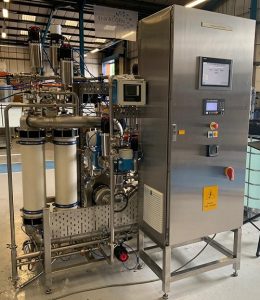
The system is designed on a modular skid mounted concept which is compact and allows for future process expansion. Both skid and module housings are constructed in stainless steel ensuring long service life with each membrane contactor containing hundreds of asymmetrical capillary membranes. Fibres are potted uniformly within a stainless steel support sleeve. HMI operator screen and PLC are used to display system data and allow operator input functionality. SCADA interface is also available depending on your production requirements.

Click here to see more information about the crossflow system at Universal Beverages, part of the Heineken group

PureFlow StepFlow® Filtration System

The PureFlow Stepflow system is an automated membrane filtration system pioneered by Begerow (www.begerow.com). The stepflow can be used for coarse, fine or membrane filtration.
Stepflow filters are fully automated bespoke systems, coming as stand-alone units put on a base frame. However they are fully scalebale and so multiple units can be put onto one or more duplex skids. Each filter or unit has its own control with an operator panel.  Our systems are fully automated, with controls in place to provide automatic change over between lines if required; however it can also be linked to an operator station for permission to changeover.

The system can be bespoke to the applications exacting requirements. For example with  a duplex skids it is possible to have one in filtration mode whilst another is in regeneration. The regeneration process is fully automated to start when it is required depending on the quality and volume of the liquid. The regeneration and integrity test is fully automated and therefore, It is not possible for filtration to start with a negative integrity test.

As previously mentioned, the Stepflow systems are fully integrated within an entire plants control system, enabling all facets of the production line to be interlinked; so, when production is required all components in the process communicate with each other.
Benefits of the stepflow system:

  • Usage of cartridges is optimised
  • Fully automated and user friendly
  • Minimised manpower
  • Environmentally friendly – reduced water consumption and reduced costs
  • No usage or disposal of filter powders
  • Enclosed self regenerating system and sterilisation program
  • Remote maintenance via analogue/digital modem
  • Local experienced engineers

Puresep recently installed a stepflow system at Constellations brand new bonded warehouse in Avonmouth –
click here to read more

Onsite Nitrogen Generation using membrane technology

Nitrogen is used throughout industry to eliminate the problems of oxidisation and for purging and blanketing chemical storage vessels to prevent explosion. Typically, around 95% of all applications use nitrogen supplied via bottles, Dewars or liquid storage tanks. Although these systems can provide an efficient supply of gas, they can often be expensive to maintain and operate, with installation, equipment rental, shipment costs and environmental charges leading to a relatively high cost for each cubic metre of gas used.

The alternative to bulk storage is to use on-site nitrogen generation systems that use specialised technology to separate nitrogen and oxygen from compressed air streams. 

Puresep is proud to offer a low cost, on demand nitrogen generation system. Using an advanced hollow fibre membrane technology, the cost comparisons show there is a lower cost of ownership compared with both competing generators and bulk storage facilities and importantly, it allows gas to be produced quickly and simply on-site at a low cost per cubic metre.

Although the potential cost savings for those companies already using a nitrogen supply can be considerable, typically between 25% and 50% depending on current gas prices, there is also the added advantage of being able to generate nitrogen on-demand and, in many applications, at the point of use.

Puresep also offer system service support, tailored to suit individual site requirements; giving regional client support and process and equipment service, resulting in long term reliability and optimal system performance.

Benefits of an on-site nitrogen generation system include:

  • Cost savings of typically 25-50%
  • Nitrogen on demand
  • Lower costs through reduction in energy consumption 
  • Each system can be used across numerous applications
  • Longer operating life
  • Increased efficiency
  • Simple and easy to install
  • Service Support – resulting in reliability and optimal system performance

For more technical information please download the press release

Pureflow Reverse Osmosis

Reverse osmosis is a membrane technology process that employs the use of pressure to force a fluid through the membrane. It is the opposite of the natural osmosis function, in which a substance moves across a membrane from an area of high concentration to an area of low concentration. The process separates water from dissolved ions and compounds to form a clean stream (permeate) and a waste stream (reject). The RO process can reject up to 99.9% of viruses, bacteria, and pyrogens and up to 99% of dissolved ions and organic compounds.
Pre treatment requirements for RO systems depend on the feed water quality. Membrane life and cleaning frequency can be optimised with the correct up stream treatment regime. Puresep will assess the feed water quality and can advise on this – however typical pre-treatment options can include:

  • Dual/carbon media filtration
  • Water softening
  • Cartridge filtration
  • Chemical injection

Puresep’s systems are modular skid mounted and compact in design allowing for future expansion. Process control systems for forward flow, re-circulation, process alarms and cleaning cycles range from manually operated control panels to PLC controlled plant with operator touch screen, SCARA interface and actuated valve assemblies – all implemented by Puresep’s engineers.
Please see attached press release for how a leading soft drinks manufacturer chose Puresep’s PureFlow Reverse Osmosis plant for the production of treated product water.

Reverse Osmosis Case Study

Pressure Leaf Filters

A popular filtration method is the use of pressure leaf filters. Either vertical leaf filters, or horizontal leaf filters. These filters consist of vertical vessels and horizontal vessels respectively. These filters also consist of filter leaves that are made up of several layers of wire mesh. The inner mesh is for discharging filtrate and also to support the outer layers.

Advantages of leaf filtration include:

  • Fully customised
  • Engineered to operate with minimum amount of maintenance
  • Fully automated
  • Cost effective and available in various sizes and capacities
  • Suitable for large filtration without the use of much floor space
  • Simple mechanism – user friendly
  • High productivity due to the high rate of filtration
  • Compact operation and thus no spillage.

In the vertical pressure leaf filter, the slurries or mixtures are pumped into the vessel with the use of pressure. The vessel is fitted with vertical leaves that serve the purpose of the filters. Each leaf has a centrally located neck at the bottom and collects the filtrate. The leaf is constructed in such a way with ribs on both sides, which allows the filtrate to flow freely towards the neck. The leaf is also covered with coarse mesh screens that support the fine woven filter cloth that retains the cake. The space between the leaves vary in size depending on the formation of the cake and also the ability of the vacuum to hold the cake to the vertical leaf surface. The filtered cake is then dried and is discharged with the help of a pneumatic vibrator through the cake discharging outlet. The wet cakes are discharged through the small opening and the dry cakes are let out through the larger opening.

Horizontal leaf pressure filter

Horizontal pressure leaf filters are used for numerous filtration purposes, to separate or filter all kinds of liquid from impure and unwanted particles that are present in liquids.

This type of filter consists of a stack of plates that are attached to a hollow shaft, which is mounted inside a pressure vessel. Each plate is covered with a suitable filter medium. Every plate is circular in shape and has radial ribs that are welded to the bottom and also supports a horizontal coarse mesh screen which is covered with a finer woven metal screen or filter cloth which is used to retain the cake. The bottom of the plate slopes towards the hollow central shaft, which lets the filtrate flow freely through circumferential holes and further down the shaft towards the filtrate discharging outlet.

The Horizontal Pressure Leaf Filter also consists of vessels which are constructed vertically to accommodate the plates stack. The bottom design for this type of machine are available in two types namely Conical Bottom and Dished Bottom. The vessels at the bottom have secure cake discharge outlets, which ensures the safe sealing of the tank even under pressure. The tanks which have a conical bottom discharge the cake by gravity, and the tanks with dished bottoms consist of a spade that rakes and transports the cake towards the outlet. Because of this reason, the conical bottoms require more headroom than the dished bottom having the same filtration capacity.

The slurry or mixture is put into the vessel through the opening with the help of pressure. The cake which is retained by the filter medium forms on top of each plate while the filtrate passes through the hollow shaft. The cake is then dried and with the use of pressure, the plate stack are rotated and thus, the cake is released through the cake discharge outlet. The cake outlet interlocks after the discharge with a motor drive as the rotating is continuous.

Candle Filters

Candle Filters consist of candle shaped filter elements made out of pipes. Every candle is enclosed with filter hose in Polyester, Nylon, Polypropylene or PVDF and is arranged vertically in a pressure vessel. The number of candles to be fitted depends upon the filtration area. The filtration and cake formation takes place under pressure and the wet or dry discharge is possible through blow back.

Advantages:

  • Safe and hygienic operation
  • Complete process and operator safety
  • Quick turnaround time
  • Flexible filtration rating in the same equipment
  • Higher cake holding capacity
  • Least pressure drop, longer run time
  • Zero emission to environment

Sheet Filters

Puresep supply a full range of sheet filters and plate and frame filters varying from 20cm up to 200cm units. These can be offered in a variety of formats and materials. Our engineers can provide advice regarding the exact size and number of plates and/or plates and frames needed to match the desired throughput.

We can also supply reconditioned sheet filters and plate and frame filters, as well as reconditioning the sheet filters and plates and frames you already have in place whilst supplying spares. All filters are rebuilt to exacting standards and the customer's specification to achieve "as good as new" quality.

Please contact us today for more information.

Depth Filtration – filter sheets

These filter sheets we supply are manufactured by our partner company Begerow

Our filter sheets are tailored especially for applications where purity and quality are paramount. From the removal of coarse matter right through to sterilising filtration, we have a product suited for all applications. All products are carefully manufactured and tested to provide particular filtration characteristics to ensure consistent product quality.

Sheets supplied range in size and micron rating and include:

  • Depth filter sheets - for the filtration of liquids. The filter sheets of this series cover a complete range of filtration grades from 4.0 µm to 0.1 µm nominal rating. In this way specific retention efficiencies can be selected for particular filtration applications.
  • Support sheets - a new type of washable, reusable protective sheet for pre-coat filtration in kieselguhr frame filters offering particularly high performance. Due to its improved wet strength and optimized surface, a service life of up to 30 pre-coating cycles is possible irrespective of the liquid to be filtered and the filter aids used.
  • Becopad sheets – The first and only mineral-free depth filter medium covering all requirements from coarse to sterile filtration. This ground breaking, innovative, depth filter media is manufactured using only high purity cellulose fibres sourced using sustainable forest management. The Becopad is 100% biodegradable, thus eliminating any regulatory disposal issues due to mineral content or synthetic fibre content in the filter media.

becopad

Filter Cartridges

Puresep PureFlow range of filter cartridges have been developed to give you longer life, greater efficiency and lower costs.

The benefits of this range to you are numerous and include:

  • Purity - Lower operating costs
  • High efficiency filtration - Technical Assistance
  • Long Service Life - Local Support and service

Whatever your filtration needs you can rely on the PureFlow range of cartridges to provide you with a proven and efficient solution. Modern manufacturing equipment is used to produce consistently efficient filters at a low cost, engineered to meet the specific requirements of your application.

This comprehensive range of filters can be used as prefilters or final filters and are suitable for use in new installations or as replacement cartridges in existing systems. The cartridges are available in micron rating from 0.2 to 90 micron absolute and available in industry standard length from 5 inches to 40 inches nominal with end fittings to suit most industry standard filter designs. Thus ensuring the cartridges can be easily and securely fitted into your existing filtration system.

PureFlow depth filters demonstrate true graded depth filtration; the results are long filter service life therefore lower consumable costs.

Cartridge Datasheet

Cartridge Housings

The PureFlow ranges of stainless steel filter housings are available in several different styles to provide economy, durability and ease of use.  They have been carefully designed for maximum performance within your filtration process. The PureFlow range of housings can be custom designed to the exact requirements of your application.

All housings are available with D.O.E. or 222 cartridge fittings, V-clamp or swing bolt lid closures are available, and inlet/outlet connections can be specified to suit the application requirements. All major flange, socket and Tri-clamp connections are available.

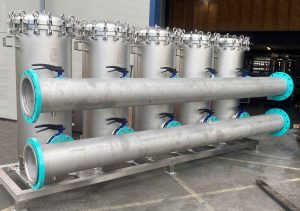
Puresep offer a range of single or multi-round filter bag vessels manufactured from 304 or 316 stainless steel.  Multi-round vessels are available with lid closure/ lifting mechanisms and swing bolt fixings.

A complete range of surface finishes, internal coating and pipe connections is offered.

Spare Parts for Orion Sheet Filters

To save you time, expense and frustration, we maintain a supply of vital and frequently required components and spare parts, pre-assembled, tested and ready for immediate installation. We can remove faulty components from site and give you approved overhauled and reconditioned components in exchange.

Spare parts include, plates, frames, seals, and if required hydraulic overhauls.

Process Treatment - Enzymes, yeasts, Filter Aid

Through Begerow we supply a range of process treatment aids that will assist you in achieving the product quality and return you require.
These include, products....

  • to increase the shelf life of beverages, by the removal of chemical and biological haze thus stabilising the end product.
  • for the clarification of liquids
  • to control the development of a particular product for example the development of wine can be controlled the application of products such as dried pure yeasts or enzymes.
  • including enzymes which offers solutions for the whole beverage industry      

Our expert engineers or Begerow specialists are extremely knowledgeable in production processes and are always happy to pay site visits to discuss your needs and make recommendations for the best use of process treatment aids.